• REGISTER NOW!! Why? Because you can't do much without having been registered!

    At the moment you have limited access to view all discussions - and most importantly, you haven't joined our community. What are you waiting for? Registration is fast, simple and absolutely free so please, join Join Talking Horses here!

Times they are a'changin'

Ian_Davies

Conditional
Joined
May 7, 2023
Messages
4,868
Location
Hampshire
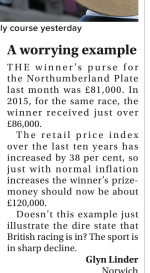
Heritage handicaps winding up with short-priced favourites (which win), Group 1 races being landed by horses with ever-diminishing ORs, is this two separate things (maybe ever more efficient data models and the exodus of equine quality to jurisdictions with better prize money) or is it all part of the same thing, namely British racing becoming of generally lower quality, hence less competitive, virtually year on year?

I see yesterday's July Cup winner had a shorter BSP than the industry SP.

It happens, and there can be a number of reasons for it, but is there an increasing tendency to believe geese are swans at the front of the market for some Group 1s which are simply declining in quality?

Marwell and Habibti won this race - the only thing yesterday's winner has in common with them is her gender.

I'm rambling (again 😂) and postulating hypotheseses which possibly contradict one another, but I sense a wave of change in British racing and, where there's change, there are betting edges, at least until the market catches up.

Hoping for a heated debate! 😂
 
I'm out of touch with how the SP is calculated these days, as it just doesn't concern me. Looking at the July Cup, it just looks like a manipulated or poorly distributed return.

Whistlejacket was surely 8/1 on course. Notable Speech must have been 11/4. I doubt anyone on course was laying 22/1 Spy Chief. There's a big disconnect between what used to be called the 'live show', which came from the track, and today's version, which is partly controlled by the big bookmakers.

If you're a punter, you need to be careful betting close to the race and make sure you're not being ripped off.

1. NO HALF MEASURES – 66/1 – 64.52


2. BIG MOJO (IRE) – 12/1 – 15.5


3. RUN TO FREEDOM – 40/1 – 70.77


4. BELIEVING (IRE) – 9/1 – 10.73


5. NOTABLE SPEECH – 85/40f – 3.85


6. JASOUR – 20/1 – 25.67


7. SPY CHIEF – 22/1 – 22.88


8. SYMBOL OF HONOUR – 4/1 – 5.9


9. ROGUE LIGHTNING (IRE) – 100/1 – 190


10. IDES OF MARCH (IRE) – 16/1 – 21


11. NIGHT RAIDER (IRE) – 28/1 – 35.31


12. WHISTLEJACKET (IRE) – 13/2 – 10


13. TWILIGHT CALLS – 150/1 – 551.73


14. FLORA OF BERMUDA (IRE) – 13/2 – 8.6
 
On the subject of official ratings—I was talking to a friend during the week about it. He mentioned Sakhee. At his peak, he was rated 136 by Timeform and 132 officially.

Think about that and compare it to Ombudsman—not with an abacus, just your eyes. Sakhee would beat the bollocks out of Ombudsman over any trip, on any ground, and with whatever lucky dip sectionals you want. I don’t think horses are any better these days; their ratings are just blown out of proportion in line with the prestigious races they run in. Unfortunately, there’s no real way to prove this—but I’m pretty confident it’s right.
 
On the subject of official ratings—I was talking to a friend during the week about it. He mentioned Sakhee. At his peak, he was rated 136 by Timeform and 132 officially.

Think about that and compare it to Ombudsman—not with an abacus, just your eyes. Sakhee would beat the bollocks out of Ombudsman over any trip, on any ground, and with whatever lucky dip sectionals you want. I don’t think horses are any better these days; their ratings are just blown out of proportion in line with the prestigious races they run in. Unfortunately, there’s no real way to prove this—but I’m pretty confident it’s right.

The dangers of race standardisation, something I see the logic of but don't usually agree.

I argued some time back (at least ten years) that I didn't think horses were better these days compared with 50 years ago but I do think they are better trained and better looked after.

I think what the 'superpower' - I lost count of the number of times ITV called them that during the three-day meeting - breeding operations have done is, rather than breed better horses at the very top end, they've bred much more in the way of horses that can compete at the top level.

It speaks volumes that since the early 1970s, the days of Nijinsky, Mill Reef and Brigadier Gerard, only one horse has since matched or surpassed them: Frankel.

(And yet every Coolmore Derby winner since AOB started training would be good enough to win a July Cup.)
 
Liking (even though a like doesn't necessarily mean an endorsement) all the replies here - there's a Sunday papers feel that I like to this Sunday debate.

What is surely for sure is that a significant number of decent horses get sold to race abroad nowadays - I often think had Sea Pigeon been born in this era he'd have been sold to Hong Kong at the end of his 3yo season - and when you seen a 6/5 jolly win a Bunbury Cup that can barely muster a two-digit field and a 4yo filly with an OR of 105 going into the race winning a July Cup it's clear to me that racing at the top-end is becoming of lower overall quality and quantity.

There was a time when horses priced up the way My Cloud and More Thunder were for the Royal Hunt Cup would have been dismissed as rank bad value by many.

And there was a time when you couldn't have a horse like No Half Measures on your mind for a Group 1.

She was at the opposite end of the market to the other two but, what links them for me, is all three were the beneficiaries of falling standards in races which maybe don't take as much winning as was once the case.
 
The dangers of race standardisation, something I see the logic of but don't usually agree.

I argued some time back (at least ten years) that I didn't think horses were better these days compared with 50 years ago but I do think they are better trained and better looked after.

I think what the 'superpower' - I lost count of the number of times ITV called them that during the three-day meeting - breeding operations have done is, rather than breed better horses at the very top end, they've bred much more in the way of horses that can compete at the top level.

It speaks volumes that since the early 1970s, the days of Nijinsky, Mill Reef and Brigadier Gerard, only one horse has since matched or surpassed them: Frankel.

(And yet every Coolmore Derby winner since AOB started training would be good enough to win a July Cup.)

The fawning, sycophantic fans of Coolmore could do with a reality check. These hyper-capitalists are utter cunts. John Magnier wouldn’t piss on a poor person if they were on fire in his way on the street.

I look forward to the day he croaks and is replaced by MV “gave three million for one” Magnier. When he does, and the rest of the hanger-on old bastards follow, they’ll be left with no super stallion—just a kazillion Galileo mares all on time decay.

They haven’t been good for the game. They’ve single-handedly destroyed the middle-distance division forever.

Now ask me what I really think.
 
Liking (even though a like doesn't necessarily mean an endorsement) all the replies here - there's a Sunday papers feel that I like to this Sunday debate.

What is surely for sure is that a significant number of decent horses get sold to race abroad nowadays - I often think had Sea Pigeon been born in this era he'd have been sold to Hong Kong at the end of his 3yo season - and when you seen a 6/5 jolly win a Bunbury Cup that can barely muster a two-digit field and a 4yo filly with an OR of 105 going into the race winning a July Cup it's clear to me that racing at the top-end is becoming of lower overall quality and quantity.

There was a time when horses priced up the way My Cloud and More Thunder were for the Royal Hunt Cup would have been dismissed as rank bad value by many.

And there was a time when you couldn't have a horse like No Half Measures on your mind for a Group 1.

She was at the opposite end of the market to the other two but, what links them for me, is all three were the beneficiaries of falling standards in races which maybe don't take as much winning as was once the case.

The only pushback I’ll give here is that if they can’t inflate the ratings to hide how bad it is anymore, then that’s no bad thing.

We all hear rumours about how most trainers in Newmarket—and further afield—are skint. We're seeing the same consolidation of good horses between a small group of owners, which, on a tangential point, means Ed Chamberlain and co. have to fawn over these Sheikh bastards who got their money through birth, not graft.

If you’re a middle-of-the-road trainer, your job is to find a 100+ horse and sell it for as much dough as you can squeeze out of the overseas market.
 
... when you seen a 6/5 jolly win a Bunbury Cup that can barely muster a two-digit field and a 4yo filly with an OR of 105 going into the race winning a July Cup it's clear to me that racing at the top-end is becoming of lower overall quality and quantity.

There was a time when horses priced up the way My Cloud and More Thunder were for the Royal Hunt Cup would have been dismissed as rank bad value by many.

And there was a time when you couldn't have a horse like No Half Measures on your mind for a Group 1.

It was mentioned on TV that the 6/5 jolly had scared away a third of the maximum field. In the past some short-priced favourites in the big handicaps were poor value - some won, some lost - but anybody who follows racing even if it's just on TV could see that More Thunder was the most likely winner by some way. Had Aalto not run it would have won by a good margin and Aalto had a good chance on its form in the race last year. Why the market ignored it to the extent that it did (14/1 on Thursday) is one of punting's mysteries.

Full disclosure, I had MT in a win double with Archivist at York, another shortie in a big handicap, and expected to collect but all the figures did point to the latter having plenty to do. I knew I was backing the trainer rather than the horse and it proved to be the kind of bad value bet you referred to.

Every day is a school day.
 
The fawning, sycophantic fans of Coolmore could do with a reality check. These hyper-capitalists are utter cunts. John Magnier wouldn’t piss on a poor person if they were on fire in his way on the street.

I look forward to the day he croaks and is replaced by MV “gave three million for one” Magnier. When he does, and the rest of the hanger-on old bastards follow, they’ll be left with no super stallion—just a kazillion Galileo mares all on time decay.

They haven’t been good for the game. They’ve single-handedly destroyed the middle-distance division forever.

Now ask me what I really think.
This is the stuff I like to read (whether I agree with it or not).

Everything is relative in life and Coolmore are only sharp relative to their principal contemporary competitor, an operation headed by a bloke who inherited every penny he has.

I actually feel sorry for Aidan O'Brien as he's essentially their slave and marketing mouthpiece and he seemed like a really nice fella the only time I ever spoke to him.

But very wealthy people often aren't very good at treating the talented people they employ with respect.

I was once gobsmacked when a financier I was in conversation with told me he planned to instruct the top-flight football manager of a football club he owned to walk around the technical area with a big walkie talkie with a placard for a product he owned and wanted promoting emblazoned on it.

Using the bloke as a sandwich board man - and using him in the course of doing his job.

I found the disrespect staggering.
 
In theory, selective breeding should produce better and better horses over time (a long time :unsure:) so, again in theory, that should be reflected in the ratings?
 
I can't see how timeform could be artificilly inflating the ratings of GP1 winners. I also can't see how it could be possible, unless all grades of horses are collectively getting slower, but again, this would be reflected in STD times becoming easier to get, yet they're not, they're very slowly becoming harder to get.

From a time analysis perspective, they'll surely consider the sections and overall times of large HCP's as having most influence, then look at the smaller field GP races, before finally considering the meeting as a whole. Which brings me to the super horses of yesteryear and I ask if there's footage of an entire meeting to be found (or at least a few races of a meeting)? If there is, then it wouldn't be too hard to check for markers to make sure the distances were actually the same, adjust accordingly, then retrofit todays STD times and apply them, while also taking manual sections from both past and present footage.

I'm inclined to think there was the odd world class super star bred back in the day, maybe as good, but probably only close to todays super stars, but the lower classes of horse, say those rated 100, were slower than todays 100 rated (which is shown in the STD's becoming slightly harder to get every few years). So it's these super stars from decades ago that actually had inflated SF's. That's my controversial take on it.
 
I can't see how timeform could be artificilly inflating the ratings of GP1 winners. I also can't see how it could be possible, unless all grades of horses are collectively getting slower, but again, this would be reflected in STD times becoming easier to get, yet they're not, they're very slowly becoming harder to get.

From a time analysis perspective, they'll surely consider the sections and overall times of large HCP's as having most influence, then look at the smaller field GP races, before finally considering the meeting as a whole. Which brings me to the super horses of yesteryear and I ask if there's footage of an entire meeting to be found (or at least a few races of a meeting)? If there is, then it wouldn't be too hard to check for markers to make sure the distances were actually the same, adjust accordingly, then retrofit todays STD times and apply them, while also taking manual sections from both past and present footage.

I'm inclined to think there was the odd world class super star bred back in the day, maybe as good, but probably only close to todays super stars, but the lower classes of horse, say those rated 100, were slower than todays 100 rated (which is shown in the STD's becoming slightly harder to get every few years). So it's these super stars from decades ago that actually had inflated SF's. That's my controversial take on it.

Without wishing to sound patronising, Chris, there's loads of logic in there.

The [UK/IRE] racehorse population must be double what it was 30 years ago, I reckon, and for that reason I reckon there are more horses rated around the 100 mark, probably partly down to breeding but we're still not, in my opinion, seeing the kind of superstar - Frankel apart - of yesteryear that you'd imagine selective breeding should produce.

Organisations like Timeform, the BHA, etc, have invested probably millions into computer-generated data geared towards assessing ability and putting a numerical value on that ability which, in turn, allows for comparisons across generations.

Plenty of horses have put up mid-130 figures over the years. Sakhee, as mentioned, Marienbard, Harbinger, etc.

A quick check via the RP suggests that there was no real consistency there, though.

Sakhee hit 135 and 134 on RPRs at York and Lonchamp in successive race but otherwise didn't hit 130.

Marienbard gave the 126-rated High Chaparral 8lbs (wfa, but that's over-generous according to some) and a beating in the Arc and was packed off to stud.

Harbinger is one I've always struggled to get my head round. He was an improving 123 horse going into the KG but that 11-length win, on top of the 12lbs wfa, looked mindblowing. The next three were 119, 117 and 116 so his 135 RPR would be in the right ball park but I wonder if sectionals would shed a different light on what happened. Did the race metrics exaggerate his superiority? Again, they didn't hang around to let him back it up. He didn't race again.
 
I can't see how timeform could be artificilly inflating the ratings of GP1 winners. I also can't see how it could be possible, unless all grades of horses are collectively getting slower, but again, this would be reflected in STD times becoming easier to get, yet they're not, they're very slowly becoming harder to get.

From a time analysis perspective, they'll surely consider the sections and overall times of large HCP's as having most influence, then look at the smaller field GP races, before finally considering the meeting as a whole. Which brings me to the super horses of yesteryear and I ask if there's footage of an entire meeting to be found (or at least a few races of a meeting)? If there is, then it wouldn't be too hard to check for markers to make sure the distances were actually the same, adjust accordingly, then retrofit todays STD times and apply them, while also taking manual sections from both past and present footage.

I'm inclined to think there was the odd world class super star bred back in the day, maybe as good, but probably only close to todays super stars, but the lower classes of horse, say those rated 100, were slower than todays 100 rated (which is shown in the STD's becoming slightly harder to get every few years). So it's these super stars from decades ago that actually had inflated SF's. That's my controversial take on it.

Apologies, but I had to stop reading after two sentences. Timeform gets far too much reverence.
 
Apologies, but I had to stop reading after two sentences. Timeform gets far too much reverence.
I don't rate them either, but you've missed my point. While many other factors are at play and the clock doesn't rule supreme, I do think it has it's place. I forget who said this, but it was along the lines of, "the clock doesn't show you how good a horse is, but it does show you how bad it isnt". However, that's irrelevant to what I was saying, which to me is both logical and meaningful to the topic.

Maurice, there might be double the horses now compared to 30 years ago, theres also double the amount of races. But take out anything below 75 and it's not much different imo.
EDIT, on my main PC, I have 26 years of flat data, so I'll look it up tomorrow.

I stand by my point, that horses have got quicker, else why have STD's got shorter? Yesteryears wonder horses may have been the same or very close to todays top horses (the very thickest cream tastes the same today as it always did). However, if you could stick a 100 rated HCPer in a time machine and run it in the 1960's - 70's, then the wonder horses from that era perhaps wouldn't look so hot and (by default) these comparisons through the ages may tell a different tale.
 
The dangers of race standardisation, something I see the logic of but don't usually agree.

I argued some time back (at least ten years) that I didn't think horses were better these days compared with 50 years ago but I do think they are better trained and better looked after.

I think what the 'superpower' - I lost count of the number of times ITV called them that during the three-day meeting - breeding operations have done is, rather than breed better horses at the very top end, they've bred much more in the way of horses that can compete at the top level.

It speaks volumes that since the early 1970s, the days of Nijinsky, Mill Reef and Brigadier Gerard, only one horse has since matched or surpassed them: Frankel.

(And yet every Coolmore Derby winner since AOB started training would be good enough to win a July Cup.)
There is one scandalous omission from that statement in your penultimate paragraph: Sea The Stars.

Putting that aside, your point doesn’t make much sense anyway because you’re talking about a tiny number of horses that by definition don’t come along very often.
 
I've never been a fan of Timeform's ratings but do usually buy their horses to follow booklets because they're much more likely to have had people looking at the 2yos and lower-class 3yos than I'd look at. Their essays used to be grammatically flawless but they have gone downhill quite a bit too.

However, 'the industry' tends to form its main opinions on Timeform's information. I sometimes think some trainers use TF to decide which race to go for because they can't gauge their own horses' ability themselves, ITV certainly do their bit to promote them and for some time until very recently ATR cards incorporated Timeform as a guide.

Chris, I'm not about standard times. As I said elsewhere recently, RP Standard Times have been gradually working back towards Ken Hussey's old STs from the latter part of last Century. To me that just means the premises on which the RP STs were calculated were flawed. I can accept that some of KH's STs were inaccurate but since I only use my time ratings (based on those old STs) to get a rough handle on I'm happier using them than the RP ones.

But the original assertion that times are a-changing is fundamentally true. There would probably be something wrong if they weren't.
 
Harbinger is one I've always struggled to get my head round. He was an improving 123 horse going into the KG but that 11-length win, on top of the 12lbs wfa, looked mindblowing. The next three were 119, 117 and 116 so his 135 RPR would be in the right ball park but I wonder if sectionals would shed a different light on what happened. Did the race metrics exaggerate his superiority? Again, they didn't hang around to let him back it up. He didn't race again.

If you look at the following race for 3yo's over the CD, they clocked really well acording to TS (obviously using the same STD as the KG), but really didn't do much afterwards, with the exception of what had been the leader, but even that wasn't that good. From memory, topspeed back then would take an average of the three fastest races against the STD's on the card, then use that average to determine the GA and SF's were automatically produced from that. Edwards may not have been using different allowances for straight and round courses at that time either, further accentuating the 1M4F SF's.

I'm not detracting from Harbingers performance, which was good, no doubt about it. The simplicity of RPR's of x beat y by so much, therefore..., just doesn't wash with me. IMO Harbinger wasn't slowing, but the others were. I would have rated that KG at the time, but no idea which laptop they're on. Gut instinct, having looked at the card again, maybe 121 - 122, with potential for 126 - 127 . Meanign if I were the HCPer, I'd be rating it 127, not 135.
 
Heritage handicaps winding up with short-priced favourites (which win), Group 1 races being landed by horses with ever-diminishing ORs, is this two separate things (maybe ever more efficient data models and the exodus of equine quality to jurisdictions with better prize money) or is it all part of the same thing, namely British racing becoming of generally lower quality, hence less competitive, virtually year on year?

I see yesterday's July Cup winner had a shorter BSP than the industry SP.

It happens, and there can be a number of reasons for it, but is there an increasing tendency to believe geese are swans at the front of the market for some Group 1s which are simply declining in quality?

Marwell and Habibti won this race - the only thing yesterday's winner has in common with them is her gender.

I'm rambling (again 😂) and postulating hypotheseses which possibly contradict one another, but I sense a wave of change in British racing and, where there's change, there are betting edges, at least until the market catches up.

Hoping for a heated debate! 😂
I get the point about short priced favourites winning top handicaps, but having had an early trawl through the International, Golden Mile and Stewards Cup entries, I'd say we've all got some proper good puzzles to solve, rather than to over philosophize about racing pyramids. "Betting edges", more of this talk please, Ian.

One of the most popular and over used phrases of the 21st century seems to be the simple and effective, 'it is what it is', and that applies here too doesn't it. Of course I'm in a smug zone today after backing a 66/1 yesterday. The racing world is fine and dandy at the moment then.
 

Recent Blog Posts

Back
Top